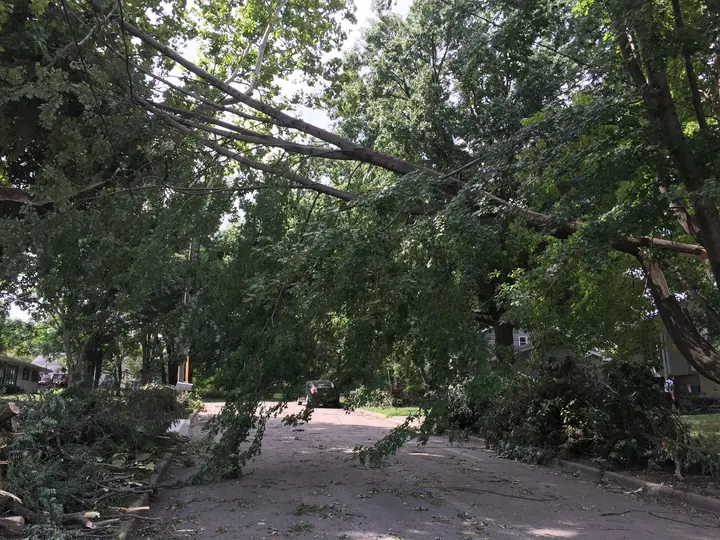
First, is it a City parkway tree?
Joliet’s parkway is the strip between the sidewalk and the road. Trees in that strip are maintained by the City’s Forestry Division (Joliet tree and tree limb removal). The City says it has over 1,000 miles of parkways. A tree on your side of the sidewalk is a private tree, and the cleanup rules are different.
Forestry periodically prunes parkway trees to take off low branches that get in the way of people and vehicles, and to keep sight lines and signs such as stop signs clear. Those same low branches also get in the way of Roadways trucks when they sweep streets and when they remove snow and ice. Roadways says it works with Forestry to prune those low limbs (same page).
If a limb is hanging or already down after a storm, the City tells residents to call Forestry at 815-724-4046 or Roadways at 815-724-3650 (same page). This site is not the City, and it does not dispatch Forestry or Roadways crews.
What to do while ice or heavy snow is still on the tree
University of Illinois Extension’s Good Growing article, written by Emily Swihart and read here on Nov. 20, 2026, is blunt about the first impulse: do not start yanking on a loaded limb. Branches that are bent under snow, but not broken, will often recover over time without special treatment. For trees, the advice is patience (Illinois Extension: The weight of winter).
Shrubs are a little different. If you need to take snow off a shrub, Extension says to sweep upward with a broom and gently knock off loose snow. If the plant is held down by ice, or by heavy snow that will not come off easily, wait for it to melt. Forcing snow and ice off a tree or shrub can cause more damage (same page).
Once the ice and snow have melted, that is the time to look the tree over and decide what actually broke. Extension says a certified arborist can help with that assessment (same page).
Which trees take the hardest hit
The same Extension article lists the trees most likely to suffer snow and ice damage: trees with more than one central leader; clump or multi-trunk forms such as birch or serviceberry; trees with poor form, including narrow branch attachments, included bark, or an imbalanced crown; and evergreens with an upright habit (Illinois Extension: The weight of winter).
A 2021 Garden Scoop article by Ryan Pankau, also from Illinois Extension and re-read today, adds that an ice storm, by the meteorological definition used there, is ice accumulation greater than 0.25 inches, and that accumulations greater than 0.5 inches can produce heavy damage, especially when wind is involved (Illinois Extension: Ice accumulation on trees and shrubs).
That article also names species whose wood and form are prone to ice-storm damage: Siberian elm, silver maple, willows, and many conifers. Evergreens are called out again because they keep their foliage all winter, which gives ice more surface to cling to, and because many of those species have wood that is more inclined to break than to bend (same page). Joliet yards have a lot of silver maple; that species has its own notes in our silver maple guide.
If a limb is on a wire, or the tree is in the way of the street
Do not walk up to a limb that is touching a power line. Extension says to contact an arborist and the utility company (Illinois Extension: The weight of winter). For a ComEd service drop or a line on your Joliet house, start with our ComEd service-drop guide. If a line is down or someone is hurt, call 911.
In a smaller wind or rain storm — and the City’s limb-removal page is written around those events, not only winter — Roadways will pick up limbs and branches that fall from parkway trees only. If a private tree drops wood that is blocking a roadway or alley right of way, Roadways will move that wood off the right of way. It will not come into the yard to remove private-property debris (Joliet tree and tree limb removal).
Do not drag private-yard wood out onto the parkway or into the street. The City says that is prohibited and can bring fines (same page). In a minor event, the homeowner is told to cut branches to no more than 4 feet, no more than 50 pounds, bundled, with no piece thicker than 3 inches, for Waste Management’s yard-waste pickup on the regular collection day. The full split between Roadways, an Emergency Event, and Waste Management — including what changes when the City declares a major event — is in our storm debris and yard waste guide.
Snow, ice, and the street in front of the house
Roadways mobilizes when there is a measurable accumulation of snow or when conditions are hazardous, including freezing rain (Joliet snow removal). The division is responsible for over 600 centerline miles of roadway, with 45 plow trucks and a crew of 47. The City’s goal is to clear all streets within 24 hours after the snow event ends; heavier snows may take longer. Alleys are not plowed.
Plowing runs in this order: major arterial streets, hospital routes, hills, and bridges; then subdivision main routes and collector streets; then the remaining subdivision streets; then cul-de-sacs and dead ends (same page).
The City uses a mixture of rock salt and organic liquids containing sugar beet juice. It says that mix works in extremely cold conditions and is less corrosive to streets, vehicles, and vegetation, and that residents should expect a brownish residue on the streets rather than a white one (same page). That is the City’s description of its road mix. It is not a promise that salt will never affect a parkway lawn or a tree, and this guide does not invent a private-yard salt treatment.
When snow reaches two inches or more, City Ordinance 16900, Section 19-142 requires vehicles off the street (same page). Parked cars block plows. After the first pass is finished, crews will not come back just because a car was moved later, and streets that still have parked cars may wait one to two days after the initial clearing. Shoveling, plowing, or blowing snow onto a City street is a code violation. If a City plow tears up sod, the snow-removal page gives 815-724-3652 as the number to call.
After the ice melts: prune the break, not the whole tree
Once it is safe, Extension says broken or damaged limbs should be removed, and that the quality of the pruning cut matters for the tree’s recovery. Taking off more live limbs than needed can make it harder for the tree to bounce back (Illinois Extension: The weight of winter). Pankau’s article makes the same point: broken limbs cannot be repaired, but taking off the damaged wood matters for safety and for the tree (Illinois Extension: Ice accumulation on trees and shrubs).
That is ordinary storm-repair pruning, not a reason to top the tree. If you are deciding whether a standing tree should come down, start at tree removal in Joliet or the storm damage overview. Oak pruning dates, which still apply in winter planning, are in the oak wilt pruning guide.
Who to call
- Hanging or downed parkway limb, or wood blocking a street or alley: Forestry 815-724-4046 or Roadways 815-724-3650 (Joliet tree and tree limb removal).
- Snow-event questions or emergencies during weekday hours: Public Works 815-724-3650, Monday through Friday 7:00 a.m. to 3:30 p.m. Weekends, holidays, or after hours: Police non-emergency 815-726-2491 (Joliet snow removal).
- Sod damage from a City plow: 815-724-3652 (same snow-removal page).
- City Hall: 150 W. Jefferson Street, 815-724-4000, Monday through Friday 8:00 a.m. to 4:30 p.m. (both City pages).
City and Extension guidance can change. If a later City notice or a staff member tells you something different from this guide, theirs wins. We re-read the two City pages and the two Illinois Extension articles on Nov. 20, 2026.
Sources
Checked Nov. 20, 2026. If a City rule has changed since, the City’s page wins.