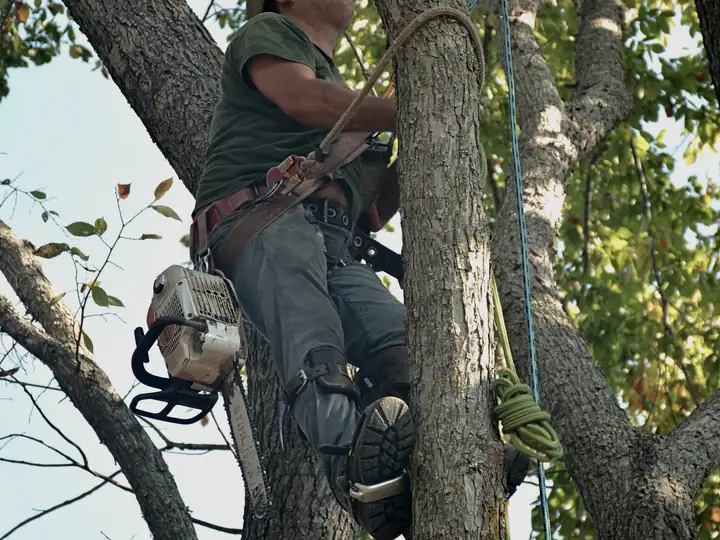
What cabling and bracing are for
The International Society of Arboriculture lists cabling and bracing as a way to add support to branches with weak attachments. On its hazards page, ISA says those supports can increase the strength and stability of weak branches and stems, but they are not a guarantee against failure. If hardware is installed, it has to be inspected regularly, and not every weak limb is a candidate (ISA: Why Hire an Arborist; ISA: Managing Hazards and Risk).
Purdue Extension, in its Large Tree Cabling and Bracing publication, describes the same idea in more detail. Cables and brace rods are supplemental supports meant to reduce the risk of failure in weak stems, branch unions, and multiple leaders. They do that by limiting how much a limb or leader can move. Purdue is plain about the limits: not all risk can be taken care of with a support system, and not every tree can be reinforced. A qualified arborist, such as an ISA Certified Arborist, should decide whether a tree is even eligible (Purdue Extension FNR-550-W).
Why this comes up in Joliet yards
Purdue says the most common structural problem behind these jobs is codominant stems — a tight V-crotch with included bark and not enough connecting wood. Overextended limbs, with the weight out at the ends, also break at the union in wind, snow, or ice (same publication).
That description fits a lot of older silver maples. The Morton Arboretum, whose main grounds are in this region, calls silver maple weak-wooded and prone to storm damage, and says that without proper, frequent pruning, high winds and ice can break limbs. Many authorities recommend against planting it (Morton Arboretum: Silver maple). Joliet's own approved species list already rules out silver maple for parkway planting, at any size (City of Joliet species list). The trees still standing in yards are leftovers from decades of planting, and they took a beating in the 2020 derecho, when NWS storm data estimated 74-knot gusts in northwest Joliet, and again in the August 11, 2026 derecho (NWS Storm Data; Herald-News).
A cable does not turn a brittle silver maple into a bur oak. Sometimes the honest answer is removal. Read silver maple in Joliet yards and, if the tree is coming down, tree removal in Joliet.
Inspection, not a one-time fix
Purdue says hardware should be checked annually for looseness and for adjustments, and that about every three years an arborist should climb the tree for a closer look. It also says some trees cannot be cabled or braced because of poor health, decayed wood, or the limits of the species (same FNR-550-W). ISA points people to an arborist with the Tree Risk Assessment Qualification when the question is how much risk a tree still poses (ISA: Managing Hazards and Risk).
Ask to see an ISA Certified Arborist credential and proof of insurance, and call the insurer to confirm it (ISA: Why Hire an Arborist). Confirm a credential at TreesAreGood.org. Get in writing whether the plan is a cable, a brace rod, or both, how often the system will be inspected, and what happens if the arborist finds decay once they are in the tree.
Parkway trees are a different question
A tree between the sidewalk and the curb in Joliet is City property. Only a certified arborist, or workers supervised by one, may prune or remove it, and residents are told to call Forestry rather than hiring that work out (Joliet Forestry). Do not hire a private crew to cable a parkway tree. Call the Roadways Division at 815-724-3650.
For a yard tree, timing and next steps still matter. Morton notes that silver maples are often pruned in summer to avoid "bleeding" sap (Morton Arboretum). Oaks follow a different calendar; see oak wilt pruning dates. If a storm already split the tree, start with storm damage and emergency tree removal. If the City has marked the tree or sent a notice, or you are deciding whether a private tree even has to come down, see dead or hazard tree assessment.
Sources
Checked Nov. 21, 2026. If a City rule has changed since, the City’s page wins.